Every great tennis match begins long before the first serve – it begins with the surface beneath the player’s feet.
India’s sports infrastructure industry has witnessed a dramatic transformation in 2026. Demand for professional-grade tennis courts is rising across residential complexes, sports academies, municipal clubs, and international-level stadiums. At the center of this revolution stands the tennis court material manufacturer – the backbone of every high-performance court built today. Choosing the right manufacturer and material directly impacts player performance, safety, maintenance cost, and court longevity. This guide delivers everything you need to make a confident, informed decision.
Table of contents
- What Does a Tennis Court Material Manufacturer Do?
- Types of Tennis Court Surfaces and Their Materials
- Key Materials Used by Tennis Court Manufacturers
- How to Evaluate a Tennis Court Material Manufacturer in India (2026)
- Comparison Table: Top Tennis Court Surface Types for Indian Conditions
- India-Specific Considerations for Court Material Selection
- Case Study: Sports Academy in Pune Transforms Training Facility
- Information Table: Typical Specifications for ITF-Recognized Hard Court Materials
- What to Ask a Tennis Court Material Manufacturer Before Buying
- Frequently Asked Questions (FAQs)
What Does a Tennis Court Material Manufacturer Do?
A tennis court material manufacturer designs, produces, and supplies the surface layers, base materials, cushioning systems, and finishing coatings used to construct tennis courts. These manufacturers operate across the full spectrum – from raw sub-base aggregates to UV-resistant acrylic topcoats and artificial grass systems.
Leading manufacturers in India now offer integrated solutions that include material supply, technical consultation, installation support, and post-installation maintenance services. The best manufacturers hold certifications from the International Tennis Federation (ITF) and follow Bureau of Indian Standards (BIS) compliance norms updated in 2026.
Upgrade Your Sports Court Today
Get premium synthetic acrylic flooring designed for durability, grip, and performance.
Get Free ConsultationTypes of Tennis Court Surfaces and Their Materials
Hard Court Materials
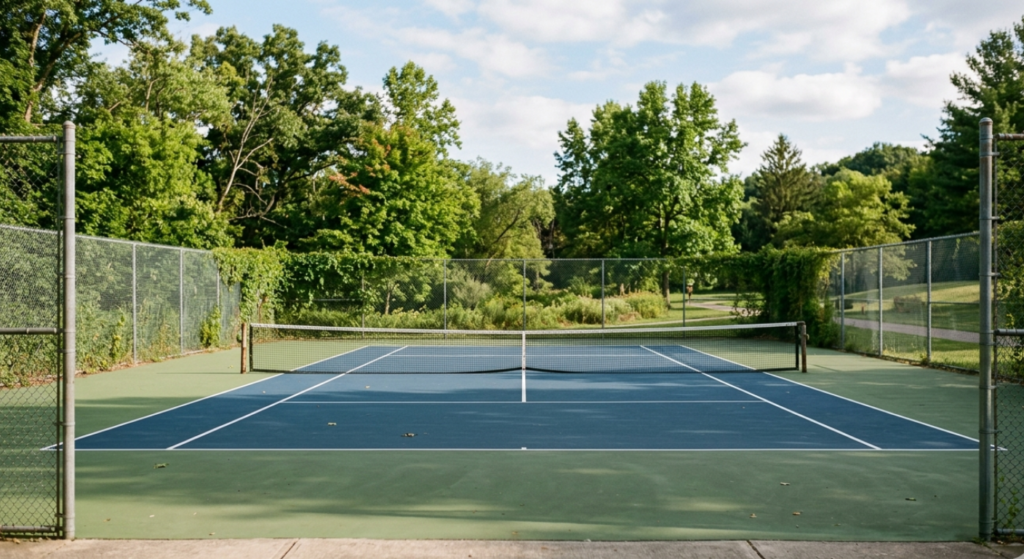
Hard courts dominate the Indian market in 2026, accounting for nearly 65% of all new court installations. Manufacturers produce these surfaces using multi-layer acrylic systems applied over an asphalt or concrete base.
The surface layers include a regulating coat, a base acrylic filler, a color coat, and a UV-stable textured finish coat. Top manufacturers use silica sand of precise granulation to control ball speed and player traction. India’s leading hard court material manufacturers now supply courts rated at ITF Pace Classification Level 2 (medium) and Level 3 (medium-fast).
Synthetic Clay Court Materials
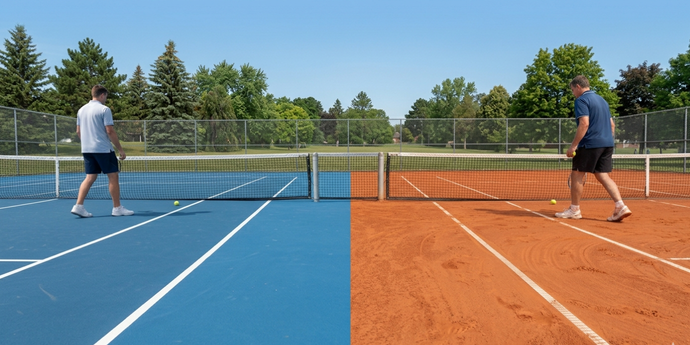
Synthetic clay courts replicate the playing characteristics of red clay without the high water consumption and daily maintenance. Manufacturers produce these using recycled rubber infill, acrylic binders, and crushed brick-coloured aggregates.
Indian manufacturers updated their synthetic clay formulations in 2026 to meet new sustainability benchmarks. The new-generation materials use 40% recycled content, making them more environment-friendly than older versions. Players benefit from the consistent, low-bounce playing style that synthetic clay delivers.
Artificial Grass Court Materials
Artificial grass tennis courts gained popularity in India’s residential and leisure segments in 2025–2026. Manufacturers supply monofilament polyethylene fibres with silica sand and rubber crumb infill systems. The fibre pile height typically ranges between 12mm and 20mm for tennis applications.
Quality manufacturers test their artificial grass for UV resistance (minimum 10-year colour guarantee), drainage efficiency (minimum 800mm per hour), and shock absorption values aligned with ITF standards.
Cushioned Acrylic Court Materials
Cushioned or “comfort” acrylic courts are a growing category. Manufacturers layer rubberized cushion compounds beneath the acrylic surface to reduce joint stress on players. India’s sports medicine community has increasingly endorsed cushioned surfaces for veteran players and training academies.
Key Materials Used by Tennis Court Manufacturers
| Material Type | Application Layer | Key Property | ITF Suitability |
| Acrylic Color Coat | Topcoat | UV resistance, traction | Hard Court (Level 2–3) |
| Silica Sand | Texture layer | Ball speed control | Hard Court |
| Rubberized Cushion | Sub-surface | Shock absorption | Cushioned Hard Court |
| Polyethylene Fibre | Surface layer | Durability, low maintenance | Artificial Grass |
| Crushed Brick Aggregate | Infill | Slide, pace control | Synthetic Clay |
| Dense Grade Aggregate (DGA) | Sub-base | Load bearing | All Court Types |
| Bituminous Macadam | Base layer | Stability, waterproofing | Hard Court & Clay |
How to Evaluate a Tennis Court Material Manufacturer in India (2026)
ITF Certification and BIS Compliance
Always verify that the manufacturer holds ITF Recognition – the gold standard for tennis surface materials globally. In 2026, the Bureau of Indian Standards updated IS 15445 norms to include new clauses on acrylic surface permeability and chemical safety. A credible manufacturer proactively shares test certificates for every product batch they supply.
Production Capacity and Quality Control
India’s top manufacturers now operate ISO 9001:2015 certified production plants with in-house testing laboratories. They conduct tests for slip resistance, colour fastness, compressive strength, and chemical composition before dispatching materials. Buyers should request factory audit reports and third-party lab certifications before finalizing orders.
Technical Support and Installation Guidance
A reliable tennis court material manufacturer provides on-site technical support teams. They guide contractors through surface preparation, application temperatures, mixing ratios, and curing times. In India’s extreme climate – especially in cities like Delhi, Mumbai, and Chennai – manufacturers now supply climate-specific formulations optimized for high heat, monsoon humidity, or coastal salt exposure (updated 2026 product lines).
Warranty and After-Sales Service
Leading manufacturers offer surface material warranties of 5 to 10 years against delamination, UV fading, and structural failure. Confirm that the warranty covers both material defects and workmanship issues when the manufacturer’s authorized contractor installs the surface.
Comparison Table: Top Tennis Court Surface Types for Indian Conditions
| Feature | Hard Court (Acrylic) | Synthetic Clay | Artificial Grass | Cushioned Acrylic |
| Initial Cost | Medium | Medium-High | High | High |
| Maintenance Cost | Low | Low-Medium | Low | Low |
| Player Safety | Medium | High | High | Very High |
| Durability | 8–12 years | 7–10 years | 10–15 years | 8–12 years |
| Weather Resistance | Excellent | Good | Very Good | Excellent |
| ITF Recognition | Yes | Yes | Yes | Yes |
| Suitable for India | All regions | North/Central | Residential | Training academies |
| Ball Bounce Quality | Consistent | Moderate | Low | Consistent |
Upgrade Your Sports Court Today
Get premium synthetic acrylic flooring designed for durability, grip, and performance.
Get Free ConsultationIndia-Specific Considerations for Court Material Selection
Climate Adaptation in Material Manufacturing
India’s geography demands climate-specific engineering. Manufacturers now produce region-specific formulations. Northern India courts require materials that withstand temperatures exceeding 45°C in summer and near-freezing winters in January. Coastal regions need salt-resistant acrylic binders. Northeastern states require materials with enhanced drainage for extremely high annual rainfall.
India’s top manufacturers updated their product portfolios in 2026 to address these regional challenges through customized surface systems.
Make in India Initiative and Domestic Manufacturing Growth
The Government of India’s Make in India initiative has directly strengthened the domestic tennis court material manufacturing sector. In 2025–2026, multiple large-scale manufacturing plants were commissioned in Maharashtra, Gujarat, and Tamil Nadu. This development reduced import dependency by approximately 30% compared to 2022 levels.
Domestic manufacturers now compete effectively with international brands like DecoTurf, Laykold, and Plexipave on both quality and pricing. Indian buyers gain the advantage of faster delivery, local technical support, and competitive pricing when choosing domestic suppliers.
Case Study: Sports Academy in Pune Transforms Training Facility
Client: A premier tennis training academy in Pune, Maharashtra Challenge: The academy operated four hard courts installed in 2013. By 2024, surfaces had cracked, drainage had failed, and players reported increased knee injuries. The academy needed a full surface replacement without stopping operations for more than three weeks.
Solution: The academy partnered with a Pune-based ITF-recognized tennis court material manufacturer. The manufacturer supplied a five-layer cushioned acrylic system over a resurfaced asphalt base. The system used a 4mm rubberized cushion layer, two acrylic base coats, a color acrylic coat, and a textured finishing coat with precision-graded silica sand.
Process: The manufacturer deployed an on-site technical team and completed the job in 18 days across four courts in sequence, keeping two courts operational throughout the project. The team also applied line marking using ITF-standard white acrylic line paint.
Results (Post-Installation, 2026):
- Player injury complaints dropped by 70% within six months
- Ball bounce consistency scored 9.2/10 in player feedback surveys
- Court surface passed ITF Pace Classification Level 2 test
- Estimated lifespan of new surface: 10–12 years with annual maintenance
- Total project cost: 35% lower than a comparable imported surface system
Key Takeaway: Choosing a certified domestic tennis court material manufacturer with strong technical support delivers measurable improvements in both performance and cost efficiency.
Information Table: Typical Specifications for ITF-Recognized Hard Court Materials
| Specification Parameter | Standard Value | Top Manufacturer Offering |
| Slip Resistance (wet) | ≥ 0.50 µ | 0.55–0.65 µ |
| Ball Rebound | 53%–58% of drop height | 54%–57% |
| Surface Regularity | ≤ 3mm per 3m | ≤ 2mm per 3m |
| Drainage Rate | ≥ 100mm/hour | 150–200mm/hour |
| UV Stability | 1000 hours (xenon arc) | 1500 hours |
| Colour Retention | ≥ 4 on Grey Scale | ≥ 4.5 on Grey Scale |
| VOC Compliance | BIS IS 15445 (2026) | Full compliance |
| Acrylic Coating DFT | 500–800 microns | 700–900 microns |
What to Ask a Tennis Court Material Manufacturer Before Buying
Questions That Reveal Manufacturer Quality
Ask every manufacturer these critical questions before placing an order. First, request their ITF Recognition Certificate number and verify it on the ITF’s official website. Second, ask for a list of completed court projects in India with contact references. Third, inquire whether their materials comply with the updated BIS IS 15445:2026 standard. Fourth, confirm whether they provide on-site technical support during application. Fifth, ask about region-specific formulations available for your city’s climate.
Manufacturers who answer these questions confidently, with documented evidence, demonstrate genuine expertise and operational credibility.
Maintenance Role of Quality Materials
The best tennis court material manufacturers build maintenance-friendly surfaces. High-quality acrylic topcoats resist algae, moss, and discolouration. They accept periodic recoating without requiring full resurfacing. Manufacturers supply maintenance kits including cleaning agents, crack filler compounds, and recoat primers that extend surface life significantly.
India’s 2026 sports infrastructure guidelines recommend that all institutional tennis courts undergo professional surface inspection every two years. Using materials from a reputed manufacturer ensures that maintenance products remain compatible and available throughout the court’s lifespan.
Conclusion
Selecting the right tennis court material manufacturer is the single most important decision in any court construction or renovation project. In India’s rapidly evolving sports infrastructure landscape of 2026, buyers have access to world-class domestic manufacturers who deliver ITF-recognized materials at competitive prices. Prioritize manufacturers with verified certifications, proven regional expertise, documented project references, and responsive technical support teams. A well-constructed court built with superior materials will deliver decades of safe, high-performance play and that investment always wins.
Frequently Asked Questions (FAQs)
A tennis court material manufacturer produces and supplies all surface materials – acrylics, cushioning layers, sub-base aggregates, and coatings used to build tennis courts.
Multi-layer cushioned acrylic systems with UV-stable topcoats perform best across most Indian climate zones in 2026.
Visit the International Tennis Federation’s official website and search the manufacturer’s name in the ITF Recognized Surfaces database.
Acrylic hard court materials typically cost between ₹150 and ₹350 per square foot depending on the number of layers and cushion specifications.
High-quality materials from certified manufacturers deliver surface lifespans of 8 to 15 years depending on usage intensity and maintenance frequency.
Yes, several Indian manufacturers hold full ITF Recognition and supply materials that meet international standards for professional tournament-grade courts.