
The debate around tennis vs pickleball has grown rapidly in recent years. Both sports are highly engaging, competitive, and social, yet they differ significantly in court size, equipment, gameplay intensity, and surface requirements. As pickleball continues expanding in clubs, residential communities, and sports complexes, many facility owners and players are comparing the two to decide which sport better suits their needs.
This in-depth guide explores every major difference between tennis and pickleball — from dimensions and rules to skill level, physical demand, and the importance of Acrylic Flooring Materials in court construction.
Table of contents
- What Is Tennis and What Is Pickleball?
- Court Dimensions: Space Makes a Big Difference
- Equipment Comparison: Racquet vs Paddle
- Rules and Gameplay: Strategy vs Power
- Physical Demand: Which Is More Intense?
- Popularity and Growth Trends
- Court Surface: Why Acrylic Flooring Materials Matter
- Construction Cost Comparison
- Skill Level and Learning Curve
- Social Aspect: Community vs Competition
- Multi-Purpose Court Advantage
- Maintenance and Longevity
- Which Sport Is Better?
- Tennis vs Pickleball: Final Comparison Table
- Conclusion
- Frequently Asked Questions
What Is Tennis and What Is Pickleball?
Tennis is a globally established racquet sport played professionally and recreationally for over a century. It requires a large court, a pressurized felt-covered ball, and a strung racquet. The sport demands speed, endurance, and powerful groundstrokes. Pickleball, on the other hand, is a relatively newer paddle sport combining elements of tennis, badminton, and table tennis. It is played on a smaller court using a solid paddle and a perforated plastic ball. The game is generally easier to learn and less physically demanding, making it attractive to all age groups. While both sports share similar fundamentals, their execution and infrastructure requirements are quite different.
Court Dimensions: Space Makes a Big Difference
One of the biggest distinctions in tennis vs pickleball is court size. A standard tennis court measures 78 feet long and 27 feet wide for singles, expanding to 36 feet wide for doubles. The larger dimensions require more movement, longer rallies, and greater endurance. In contrast, a pickleball court measures 44 feet long and 20 feet wide — significantly smaller. Interestingly, this is the same size as a badminton doubles court.
Upgrade Your Sports Court Today
Get premium synthetic acrylic flooring designed for durability, grip, and performance.
Get Free ConsultationBecause of this difference:
- Tennis demands more lateral and baseline coverage.
- Pickleball encourages faster reflex exchanges near the net.
- Tennis facilities require more land investment.
- Pickleball allows multiple courts within the same tennis court footprint.
From an infrastructure perspective, pickleball offers higher space efficiency, especially for urban projects.
Equipment Comparison: Racquet vs Paddle
Tennis Equipment
Tennis uses:
- A strung racquet
- Pressurized rubber ball covered in felt
- Higher net height (3.5 feet at posts)
The racquet allows spin-heavy strokes and powerful baseline shots. The ball travels faster and bounces higher, requiring controlled footwork and timing.
Pickleball Equipment
Pickleball uses:
- Solid paddle (no strings)
- Lightweight perforated plastic ball
- Lower net height (34 inches at center)
The paddle provides limited spin compared to tennis. The plastic ball travels slower, reducing overall pace but increasing strategic net play. Equipment cost is generally lower in pickleball, making it more accessible for beginners.
Rules and Gameplay: Strategy vs Power
When analyzing tennis vs pickleball, gameplay mechanics show noticeable contrast.
Tennis Gameplay
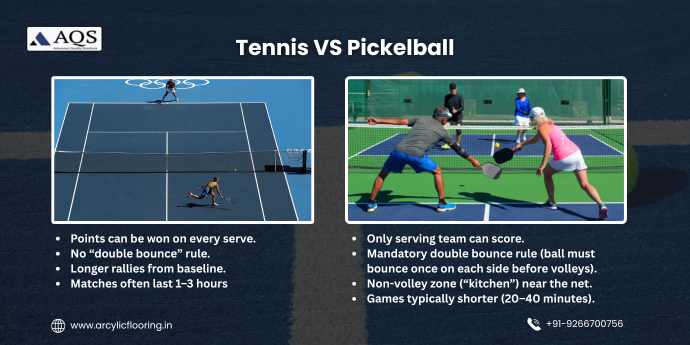
- Points can be won on every serve.
- No “double bounce” rule.
- Longer rallies from baseline.
- Matches often last 1–3 hours.
Tennis emphasizes athleticism, stamina, topspin control, and shot placement across a larger court.
Pickleball Gameplay
- Only serving team can score.
- Mandatory double bounce rule (ball must bounce once on each side before volleys).
- Non-volley zone (“kitchen”) near the net.
- Games typically shorter (20–40 minutes).
Pickleball focuses on quick reflexes, soft shots (dinks), and tactical positioning rather than sheer power.
Physical Demand: Which Is More Intense?
Tennis is physically more demanding. The larger court requires sprinting, sliding, and powerful strokes. It improves cardiovascular endurance and full-body strength. Pickleball, while still active, places less strain on joints and requires shorter movement distances. It is ideal for seniors or those seeking moderate exercise. However, competitive pickleball at higher levels can still be extremely fast-paced.
Popularity and Growth Trends
Tennis has long-standing international recognition with professional tournaments and Olympic presence. It enjoys global participation across all age groups. Pickleball has witnessed explosive growth, particularly in North America and increasingly in Asia. Residential societies, schools, and clubs are rapidly adding pickleball courts due to space efficiency and lower construction cost. For facility developers, the rising demand for pickleball is reshaping court construction strategies.
Court Surface: Why Acrylic Flooring Materials Matter
When discussing tennis vs pickleball, surface quality plays a crucial role in performance and safety. Both sports benefit from Acrylic Flooring Materials, especially in outdoor and multi-purpose facilities.
Why Acrylic Flooring Is Preferred
Acrylic surfaces offer:
- Consistent ball bounce
- UV resistance
- Anti-slip texture
- Weather durability
- Low maintenance
- Customizable speed (slow, medium, fast)
For tennis courts, acrylic systems allow controlled ball response and player comfort during extended rallies. For pickleball courts, acrylic ensures predictable bounce of the plastic ball and reduces surface abrasion. Additionally, Acrylic Flooring Materials support vibrant color combinations, making line markings clear and professional.
Construction Cost Comparison
Cost varies depending on land preparation, base construction, and surface finishing.
Tennis Court Construction Cost
- Larger land requirement
- Higher fencing expense
- Greater material quantity
- Longer installation time
Tennis courts are generally more expensive to build.
Pickleball Court Construction Cost
- Smaller footprint
- Lower material consumption
- Faster installation
- Can be built inside existing tennis court area
Pickleball courts are significantly more budget-friendly, especially for community-level projects. However, surface quality should never be compromised. Investing in professional-grade Acrylic Flooring Materials ensures long-term durability.
Skill Level and Learning Curve
Tennis requires technical stroke mastery, footwork coordination, and strength. Beginners often need structured training. Pickleball has a shorter learning curve. Even first-time players can enjoy rallies within minutes. For recreational centers targeting quick engagement, pickleball is often preferred. For competitive athletes seeking advanced skill development, tennis remains unmatched.
Social Aspect: Community vs Competition
Pickleball is highly social. Doubles play is common, and smaller courts bring players closer together, encouraging conversation and interaction. Tennis, while also social, often emphasizes individual competition, particularly in singles. Community-based housing projects increasingly install pickleball courts to enhance social engagement.
Multi-Purpose Court Advantage
One interesting aspect in tennis vs pickleball comparison is multi-sport adaptability. A tennis court size can accommodate up to four pickleball courts size within the same space by adding line markings. Using Acrylic Flooring Materials allows precise and durable multi-line painting without affecting surface performance. This hybrid approach maximizes return on investment for schools and clubs.
Maintenance and Longevity
Both courts require periodic cleaning and resurfacing.
Acrylic surfaces generally need:
- Cleaning to remove debris
- Crack filling if base shifts
- Recoating every 4–6 years
Because pickleball involves lighter equipment and less forceful play, wear and tear can sometimes be lower compared to tennis. Proper drainage, base preparation, and high-quality acrylic coating significantly extend court lifespan.
Which Sport Is Better?
The answer depends on goals.
Choose tennis if:
- You want high-intensity athletic training
- You prefer powerful rallies
- You have sufficient space
Choose pickleball if:
- You want quick learning and community play
- You have limited land
- You want cost-efficient installation
From a construction and infrastructure perspective, both sports benefit equally from premium Acrylic Flooring Materials to ensure safety, bounce consistency, and long-term durability.
Tennis vs Pickleball: Final Comparison Table
| Feature | Tennis | Pickleball |
| Court Size | 78 x 27 ft | 44 x 20 ft |
| Equipment | Strung racquet | Solid paddle |
| Ball Type | Felt-covered rubber | Perforated plastic |
| Physical Demand | High | Moderate |
| Learning Curve | Moderate to Hard | Easy |
| Space Requirement | Large | Compact |
| Surface Type | Acrylic, clay, grass | Acrylic preferred |
Conclusion
The comparison of tennis vs pickleball highlights two exciting racquet sports with distinct identities. Tennis remains a physically demanding global sport rooted in tradition, while pickleball represents modern accessibility and rapid community growth. From a construction perspective, both sports rely heavily on high-performance Acrylic Flooring Materials for durability, ball control, and player safety. As sports infrastructure evolves, many facilities are incorporating both games to maximize engagement and revenue. Whether selecting tennis for athletic intensity or pickleball for social inclusivity, investing in proper surface systems ensures long-term success.
Frequently Asked Questions
The primary difference is court size, equipment, and gameplay intensity, with pickleball being smaller and easier to learn.
Yes, pickleball has a shorter learning curve and requires less physical endurance than tennis.
Yes, one tennis court can accommodate multiple pickleball courts with proper line marking.
Acrylic Flooring Materials are ideal for both due to consistent bounce and durability.
Tennis is generally more physically intense because of its larger court and longer rallies.