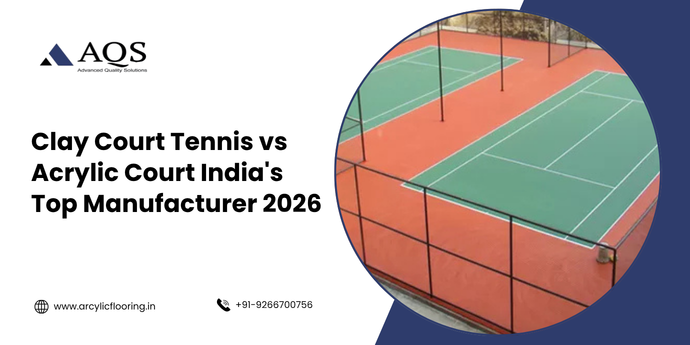
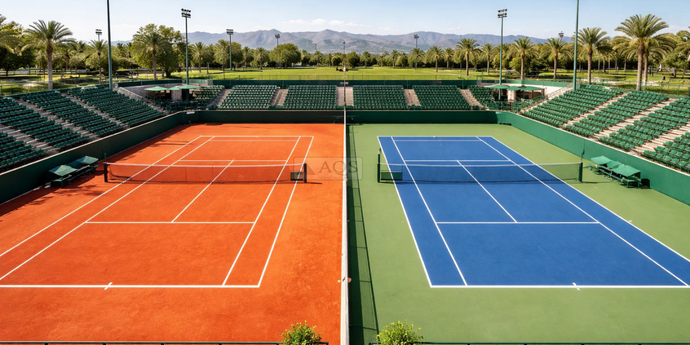
Clay Court Tennis vs Acrylic Court: Clay court tennis uses crushed brick or shale as a surface, offering slower ball speed and high spin. Acrylic courts use a multi-layer polymer coating over concrete or asphalt, delivering consistent speed, durability, and low maintenance. In India 2026, acrylic courts dominate new installations at schools, clubs, and sports complexes due to superior longevity and all-weather performance.
- Acrylic courts last 8–15 years; clay courts require seasonal resurfacing.
- Acrylic surfaces are preferred in India’s humid and monsoon-heavy climate.
- Leading Indian acrylic court manufacturers include Pacecourt, Courtsport, and Rebound Ace India.
- Clay courts offer joint-friendly play; acrylic courts offer consistent ball bounce.
- Installation cost: Clay ₹8–12 lakh; Acrylic ₹12–20 lakh (single court, India 2026).
Table of contents
- What Is a Clay Court? Surface Science Explained
- What Is an Acrylic Tennis Court? Technology, Layers & Construction
- Clay Court Tennis vs Acrylic Court: Full Comparison Table (India 2026)
- Performance Factors: Ball Speed, Bounce, and Player Impact
- Top Acrylic Court Manufacturers in India (2026 Updated List)
- What to Look for in an Acrylic Court Manufacturer in India
- Maintenance & Lifecycle Cost Analysis: Clay Court Tennis vs Acrylic Court (India 2026)
- Conclusion
- Frequently Asked Questions (FAQs)
What Is a Clay Court? Surface Science Explained
A clay tennis court consists of a crushed natural material base-most commonly brick, shale, or limestone-compacted into a firm yet porous playing surface. Players worldwide recognize clay as the slowest court surface in professional tennis. The French Open uses red clay, while some European clubs prefer green Har-Tru clay. Clay courts slow the ball significantly and generate high-friction bounces that stay lower and kick forward.
In India, clay courts gained early popularity during British colonial-era clubs in the 1900s. However, India’s tropical climate-especially heavy monsoon rainfall-creates serious maintenance challenges for clay surfaces. The porous nature of clay absorbs water quickly, making courts unplayable for hours after rain. Club managers across Mumbai, Chennai, and Kolkata report frequent downtime losses during the June–September monsoon season.
Clay requires daily watering in dry seasons to maintain the right moisture balance. Too dry and the surface cracks; too wet and it becomes slippery and hazardous. Groundskeepers apply a thin layer of fresh clay periodically to refill worn patches. This labor-intensive process adds significantly to the annual operational budget of any clay court facility.
Upgrade Your Sports Court Today
Get premium synthetic acrylic flooring designed for durability, grip, and performance.
Get Free ConsultationClay Court – Key Traits
- Slow ball speed (high friction)
- High topspin effectiveness
- Joint-friendly surface
- Natural, eco-friendly material
- Requires watering & rolling
- Slippery when wet
Acrylic Court – Key Traits
- Medium-to-fast ball speed
- Consistent true bounce
- Playable in all weathers
- Low maintenance design
- Custom color and texture
- 20+ year base lifespan
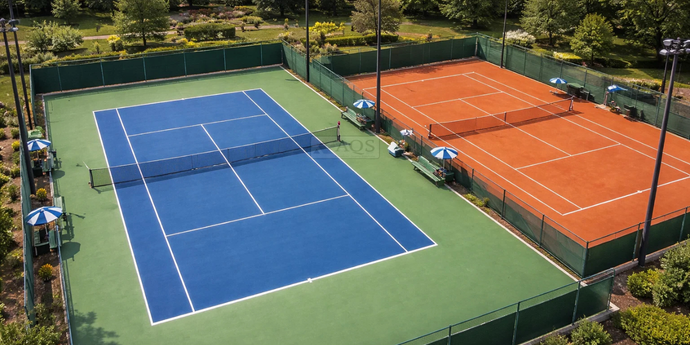
What Is an Acrylic Tennis Court? Technology, Layers & Construction
An acrylic tennis court is a multi-layer sports surface system applied over a prepared concrete or asphalt base. The surface system typically includes a base resurfacer layer, a cushion layer (in premium courts), a color coat layer, and a textured finish coat containing silica sand for friction control. Manufacturers engineer each layer to deliver specific performance properties, including ball pace, traction, and UV resistance.
Top acrylic court manufacturers in India use internationally approved ITF (International Tennis Federation) certified materials for their coating systems. The ITF classifies court surfaces by pace rating-from Category 1 (slow) to Category 5 (fast)-and acrylic courts can be engineered across this entire spectrum. This flexibility makes acrylic the most versatile tennis court surface available in 2026.
Layers of a Standard Acrylic Tennis Court System
| No. | Layer Name | Material | Function | Thickness |
| 1 | Sub-base | Compacted soil / gravel | Structural stability & drainage | 100–200 mm |
| 2 | Base Layer | Asphalt or concrete | Load distribution | 75–100 mm |
| 3 | Resurfacer | Acrylic filler compound | Surface leveling & adhesion | 2–4 mm |
| 4 | Cushion Layer | Rubber-acrylic blend | Shock absorption (optional) | 3–6 mm |
| 5 | Color Coat | Pigmented acrylic | Color, UV protection | 1–2 mm |
| 6 | Textured Top Coat | Silica sand + acrylic binder | Traction, pace control | 0.5–1 mm |
Indian acrylic court manufacturers now offer cushioned acrylic systems that add a rubber-modified layer beneath the color coat. This cushion reduces stress on players’ knees and ankles by up to 30%, closing the comfort gap that clay traditionally held over hard courts. Sports authorities across Delhi, Pune, and Hyderabad increasingly specify cushioned acrylic for school and college facilities in 2026.
Clay Court Tennis vs Acrylic Court: Full Comparison Table (India 2026)
| Parameter | Clay Court | Acrylic Court | Winner |
| Ball Speed | Slow (high friction) | Medium to fast | Acrylic (versatile) |
| Bounce Consistency | Irregular, spin-dependent | True, consistent | Acrylic |
| Player Joint Safety | Excellent | Good (cushioned) | Clay |
| Monsoon Performance | Very poor | Excellent | Acrylic |
| Daily Maintenance | High (watering, rolling) | Low (sweeping) | Acrylic |
| Annual Maintenance Cost | ₹1.5–3 lakh | ₹20,000–50,000 | Acrylic |
| Surface Lifespan | 3–5 years (resurfacing) | 8–15 years | Acrylic |
| Installation Cost (India) | ₹8–12 lakh | ₹12–20 lakh | Clay (lower upfront) |
| Color Options | Red, green, brown | Any custom color | Acrylic |
| ITF Certification | Yes (natural clay) | Yes (multiple categories) | Tie |
| Night Playability | Good with floodlights | Excellent (no dust) | Acrylic |
| Spin Play Advantage | Very high | Moderate | Clay |
| Construction Time | 7–10 days | 14–21 days | Clay |
| Environmental Impact | Natural material | Synthetic (long-lasting) | Clay (natural) |
| Resale/Club Value | Moderate | High | Acrylic |
Performance Factors: Ball Speed, Bounce, and Player Impact
The most critical difference between clay court tennis and acrylic court tennis lies in how the ball interacts with the surface. Clay courts generate a high-friction interaction that slows the ball substantially-sometimes reducing speed by 20–30% compared to hard courts. This gives baseline players more time to react, making clay a haven for tactical, spin-heavy players like Rafael Nadal.
Acrylic courts deliver a truer bounce because the surface is rigid and uniform. The ball compresses slightly on impact but rebounds predictably. This consistency suits players who rely on flat hitting, serve-and-volley tactics, and aggressive baseline play. Sports coaches across India’s academies confirm that young players develop more complete techniques when trained on acrylic surfaces.
Impact on Player Physiology and Injury Risk
Clay courts absorb significantly more impact energy than standard acrylic courts. This reduces peak ground reaction force on players’ joints by nearly 10–15% on traditional clay. Orthopedic specialists in Mumbai and Delhi have noted lower rates of stress fractures and shin splints among players trained primarily on clay. However, slipping on wet clay introduces different injury risks, particularly ankle sprains during wet conditions.
Modern cushioned acrylic systems have substantially reduced this advantage gap. Premium cushioned acrylic courts-offered by leading Indian manufacturers in 2026-now meet or exceed ITF requirements for shock absorption. Players at academies in Pune and Bangalore report comparable comfort levels on cushioned acrylic compared to clay after extended training sessions.
Top Acrylic Court Manufacturers in India (2026 Updated List)
India’s acrylic sports surface industry has grown significantly since 2020, with several manufacturers now exporting to South Asia, the Middle East, and Africa. These companies supply ITF-approved acrylic systems, cushioned court technology, and complete turnkey installation services. Choosing a certified manufacturer ensures surface quality, warranty protection, and post-installation service availability across India.
| Manufacturer | HQ Location | Key Products | ITF Certified | Warranty | Specialty |
| Pacecourt | Ahmedabad, Gujarat | Acrylic Tennis, Basketball, Badminton courts | ✅ Yes | 5–10 years | Budget to premium range; school specials |
| Courtsport India | Mumbai, Maharashtra | Cushioned acrylic, polymeric surfaces | ✅ Yes | 7 years | Cushioned systems, club installations |
| Rebound Ace India | Bangalore, Karnataka | Rebound Ace XT, cushioned hard courts | ✅ Yes | 8 years | Academy-grade premium surfaces |
| Sprinturf India | Delhi NCR | Multi-sport acrylic, tennis-specific | ✅ Yes | 5 years | Multi-sport facility integration |
| Surfmaster Sports | Hyderabad, Telangana | Acrylic resurfacing, new installations | Partial | 3–5 years | Resurfacing existing clay/concrete courts |
| TurfMaster India | Chennai, Tamil Nadu | FIBA/ITF approved acrylic systems | ✅ Yes | 6 years | South India market, institutional projects |
Upgrade Your Sports Court Today
Get premium synthetic acrylic flooring designed for durability, grip, and performance.
Get Free Consultation
Pro Tip (2026)
Always request an ITF Classified Court Surface certificate from your manufacturer. This certificate confirms that the installed surface meets international pace, friction, and shock-absorption standards-critical for competitive play and insurance compliance in India.
What to Look for in an Acrylic Court Manufacturer in India
Selecting the right acrylic court manufacturer requires evaluating multiple factors beyond just price. A reputable manufacturer provides site inspection, soil testing, drainage design, and a detailed installation timeline before accepting payment. They offer a written warranty that covers delamination, color fading, and surface cracking-the three most common failure points in low-quality acrylic installations.
Manufacturers registered with the Sports Authority of India (SAI) and those who supply surfaces to AITA (All India Tennis Association) affiliated clubs carry significantly higher credibility. Buyers should request at least three reference sites, preferably in a similar climate zone, to inspect surface condition after 3–5 years of use.
Case Study: Bangalore Sports Academy – Clay to Acrylic Court Conversion (2024)
Bangalore Sports Academy (BSA), a prominent tennis training center in Whitefield with over 400 active junior members, has operated three red clay courts since 2008. By 2023, escalating maintenance costs, monsoon downtime averaging 62 days per year, and increasing player complaints about surface inconsistency prompted management to evaluate a full surface conversion.
BSA partnered with Rebound Ace India to convert all three clay courts into cushioned acrylic surfaces between October 2023 and January 2024. The project involved complete clay removal, concrete base preparation, and installation of a 6-layer cushioned acrylic system with blue in-court and green surround coloring per ITF specification.
Results after 18 months of use (2024–2026):
Court availability increased to 340+ playable days per year compared to 278 days on clay. Annual maintenance costs dropped from ₹2.4 lakh to ₹38,000 per year across all three courts. Member satisfaction surveys showed 87% approval rating for the new surface. Junior players’ match-play hours increased by 22% due to improved availability and consistent bounce quality.
Maintenance & Lifecycle Cost Analysis: Clay Court Tennis vs Acrylic Court (India 2026)
Total cost of ownership over a 10-year period tells a very different story than initial installation costs alone. Clay courts appear cheaper upfront but accumulate substantial recurring expenses through labor, materials, and lost revenue during downtime. Acrylic courts demand higher installation investment but deliver dramatically lower operating costs across the same period.
| Cost Item | Clay Court (10 Years) | Acrylic Court (10 Years) |
| Installation Cost | ₹10 lakh | ₹16 lakh |
| Annual Maintenance (avg) | ₹2 lakh × 10 = ₹20 lakh | ₹40,000 × 10 = ₹4 lakh |
| Resurfacing (every 4–5 yrs) | ₹4 lakh × 2 = ₹8 lakh | ₹1.5 lakh × 1 = ₹1.5 lakh |
| Downtime Revenue Loss | ₹3–6 lakh (est.) | Negligible |
| Groundskeeper Labor | ₹6 lakh (10 yrs) | ₹0.8 lakh (10 yrs) |
| Total 10-Year Cost | ₹47–50 lakh | ₹22–24 lakh |
The data above clearly demonstrates that acrylic court tennis surfaces deliver better long-term financial value in India’s climate conditions. Even accounting for the higher upfront installation cost, facility operators save approximately ₹25–28 lakh per court over a decade when choosing a quality acrylic system over traditional clay.
Conclusion
The debate between Clay Court Tennis vs Acrylic Court tennis ultimately comes down to your specific context, climate, and goals. Clay courts remain valuable for joint-friendly training environments and clubs in dry climates that can sustain dedicated maintenance teams. They preserve tennis tradition and offer unique playing characteristics that develop tactical baseline skills in young players.
Acrylic courts, however, represent the clear choice for modern tennis infrastructure in India in 2026. Their all-weather performance, dramatically lower maintenance costs, consistent playing surface, and long operational lifespan make them the preferred choice for schools, academies, clubs, and sports complexes across every Indian state. Leading acrylic court manufacturers in India now offer globally competitive products with full ITF certification and robust post-installation support.
Whether you manage a three-court community club in Pune or a twelve-court academy in Delhi, partnering with a certified, experienced acrylic court manufacturer delivers the best long-term return on your sports infrastructure investment. Request detailed quotes from at least two ITF-certified manufacturers, inspect reference installations, and demand written warranties before committing to any surface choice.
Frequently Asked Questions (FAQs)
Acrylic courts are far better suited to India’s monsoon climate, draining quickly and remaining playable within hours of rainfall.
Yes, ITF-certified acrylic courts are fully approved for AITA-sanctioned tournaments and official competitive play across India.
A quality acrylic court from a certified Indian manufacturer typically lasts 8–15 years before requiring a full resurfacing treatment.
Clay courts are traditionally gentler; however, modern cushioned acrylic systems now offer comparable shock absorption for joint protection.
A single standard acrylic tennis court costs approximately ₹12–20 lakh for complete installation by a certified Indian manufacturer in 2026
Yes, existing clay courts can be converted to acrylic by removing the clay base, preparing a concrete or asphalt sub-base, and applying the acrylic coating system.