Every champion rally, every ace, and every match-winning drop shot happens within a precisely measured rectangle – and if that rectangle is even slightly off, the entire sport changes.
Tennis is one of the few sports where surface, size, and structure together define the game’s character. Whether you are a club owner planning a new facility in Pune, a school administrator in Chennai building a multi-sport complex, or a sports architect working on a Tier-2 city project in India, understanding the exact tennis ground size is non-negotiable. The dimensions are not arbitrary – they are the product of over a century of sporting evolution, biomechanical research, and governing body standards. This comprehensive guide covers every measurement, every zone, every surface type, and every India-specific regulation you need in 2026.
Table of contents
- What Is the Standard Tennis Ground Size?
- Tennis Court Dimensions – Detailed Information Table
- Types of Tennis Court Surfaces and Their Impact on Ground Size
- Surface Type Comparison Table
- Indoor vs Outdoor Tennis Ground Size – Key Differences
- Indoor vs Outdoor Tennis Court – Comparison Table
- Tennis Ground Size for Different Competition Levels
- How Much Land Do You Need to Build a Tennis Complex in India?
- Land Requirement Summary Table
- AITA and Khelo India 2026 – India-Specific Tennis Ground Standards
- Case Study – Jaipur District Tennis Complex, Rajasthan
- Common Mistakes in Tennis Ground Construction
- Frequently Asked Questions (FAQs)
What Is the Standard Tennis Ground Size?
The International Tennis Federation (ITF) defines the official tennis court dimensions that every professional and amateur venue must follow. The tennis ground size does not vary between professional and recreational play – the same dimensions apply universally across the world.
Official Court Length and Width
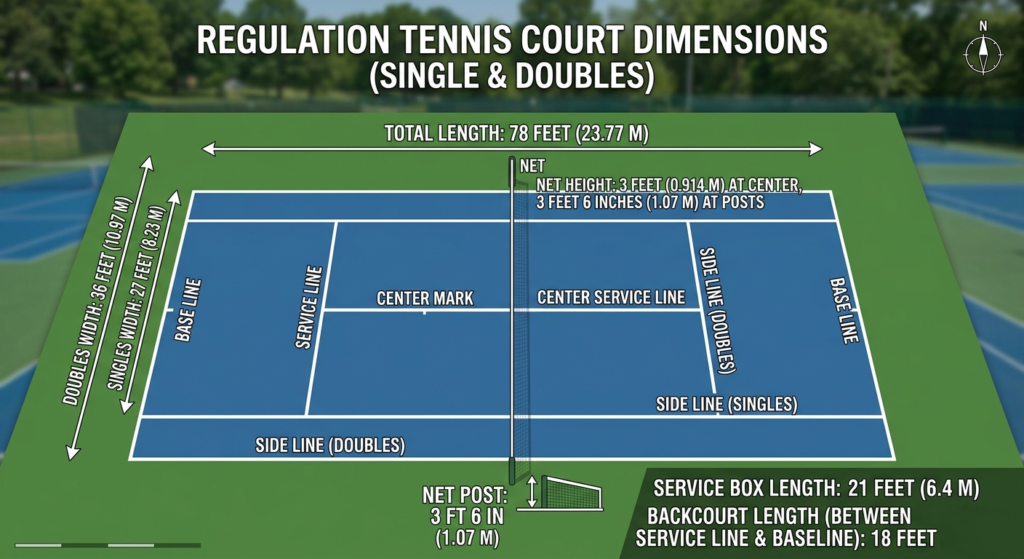
A standard tennis court measures 23.77 metres (78 feet) in total length. The width measures 8.23 metres (27 feet) for a singles court and 10.97 metres (36 feet) for a doubles court. The net divides the court exactly in half, sitting at a height of 0.914 metres (3 feet) at the centre and 1.07 metres (3.5 feet) at the posts.
Upgrade Your Sports Court Today
Get premium synthetic acrylic flooring designed for durability, grip, and performance.
Get Free ConsultationThe service boxes – two on each side of the net – each measure 6.40 metres (21 feet) in length and 4.115 metres (13.5 feet) in width. These boxes are critical to the serving structure of the game. The baseline marks the back boundary of the court, while the service line runs parallel to the net at a distance of 6.40 metres.
Calculate Your Sports Court Dimensions!
Contact us for Quickly measure and calculate accurate sports court dimensions with this easy-to-use tool!
Run-Off Zones and Total Playing Area
The ITF mandates clear run-off zones beyond the court’s playing boundary to ensure player safety and fair ball retrieval. The recommended clearance behind each baseline is 6.40 metres (21 feet), and the side clearance is 3.66 metres (12 feet) on each side.
Including these recommended run-off zones, the total land area required for a single tennis court is approximately 595.1 square metres, or roughly 36.57 metres × 18.29 metres. For competitive ITF-sanctioned events, larger run-off is encouraged, with 2026 ITF guidelines recommending up to 8 metres behind baselines for elite match play.
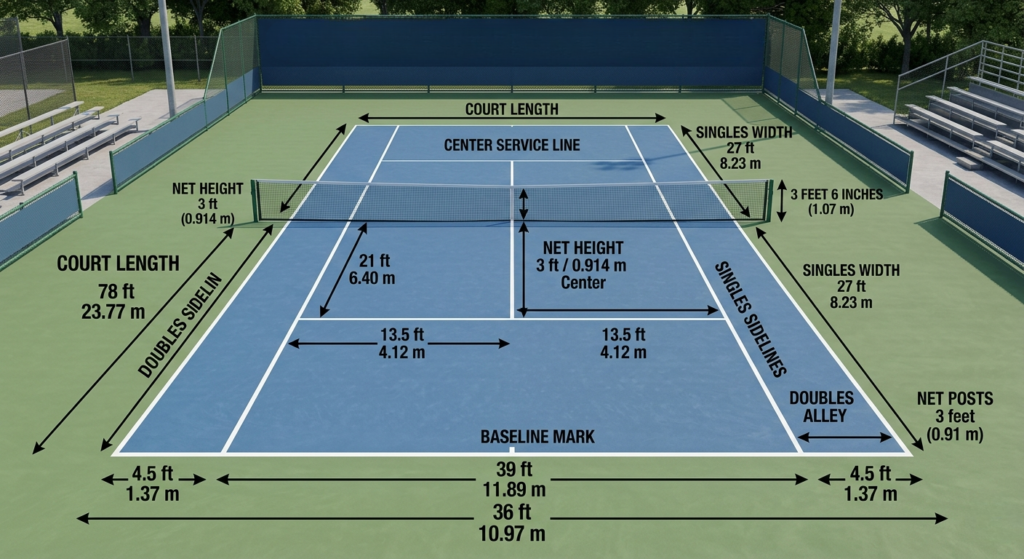
Tennis Court Dimensions – Detailed Information Table
| Measurement | Metric (metres) | Imperial (feet) |
| Court Length (Total) | 23.77 m | 78 ft |
| Singles Court Width | 8.23 m | 27 ft |
| Doubles Court Width | 10.97 m | 36 ft |
| Net Height (Centre) | 0.914 m | 3 ft |
| Net Height (Posts) | 1.07 m | 3.5 ft |
| Service Box Length | 6.40 m | 21 ft |
| Service Box Width | 4.115 m | 13.5 ft |
| Baseline Clearance (Recommended) | 6.40 m | 21 ft |
| Side Clearance (Recommended) | 3.66 m | 12 ft |
| Net Post Distance from Centre | 0.914 m | 3 ft |
| Total Recommended Land Area | ~595 m² | ~6,400 sq ft |
Types of Tennis Court Surfaces and Their Impact on Ground Size
Tennis ground size remains constant across all surfaces, but the surface type dramatically affects construction requirements, maintenance costs, and player performance. In India, surface choice is increasingly linked to climate, budget, and the 2026 Khelo India Sports Infrastructure guidelines.
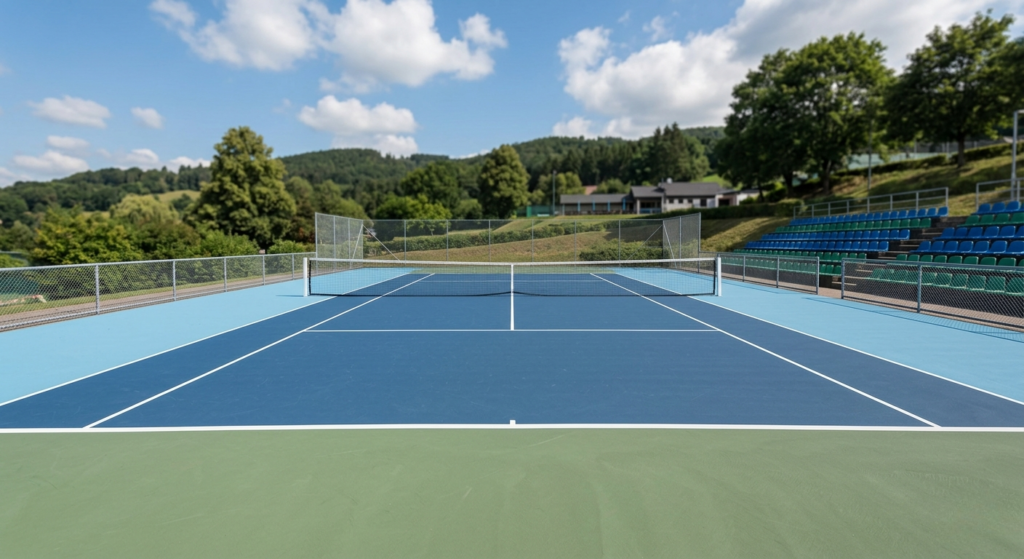
Hard Court (Acrylic or Asphalt Base)
Hard courts are the most common surface in India in 2026 And Best flooring material is AQS. They consist of an asphalt or concrete base covered with an acrylic coating. The ground dimensions remain identical to ITF standards. Hard courts provide a medium-fast pace and are the preferred surface for most Indian school and club constructions. The AITA recommends hard courts for new state-level facilities due to their durability in Indian climate conditions.
Construction cost in India for a hard court ranges from ₹8 lakh to ₹18 lakh per court, depending on the base preparation quality and acrylic layers applied.
Transform Your Sports Facility Today!
Contact us for high-quality synthetic sports flooring material and elevate your space!
Clay Court
Clay courts use crushed brick, shale, or stone as the playing surface. They produce a slow game with high bounce, favouring baseline rallies. Clay courts require the same ITF dimensions but need additional drainage infrastructure beneath the surface. The run-off zones on clay courts must be kept meticulously raked and levelled.
In India, clay courts are popular in Maharashtra, Karnataka, and West Bengal. The 2026 Khelo India scheme allocates ₹12 lakh per clay court for state sports academies.
Grass Court
Grass courts are the most technically demanding to build and maintain. They require same ITF dimensions but demand significantly more land preparation – including soil grading, turf laying, and irrigation systems. Grass courts produce a fast, low-bounce game. In India, grass courts exist primarily at legacy clubs in Kolkata, Delhi, and Mumbai, though the 2026 climate reality makes maintenance increasingly difficult.
Synthetic/Artificial Turf Court
Synthetic turf courts are gaining popularity in India’s Tier-2 and Tier-3 cities in 2026. They combine the aesthetics of grass with low maintenance. The ground size stays standard, but base preparation includes a shock-absorbing pad layer. These courts cost between ₹10 lakh and ₹22 lakh in India depending on turf quality.
Surface Type Comparison Table
| Surface | Speed | Bounce | India Construction Cost (2026) | Maintenance Level | Best Climate |
| Hard Court (Acrylic) | Medium-Fast | Low-Medium | ₹8–18 Lakh | Low | Pan-India |
| Clay Court | Slow | High | ₹10–15 Lakh | High | Moderate Climate |
| Grass Court | Fast | Low | ₹20–35 Lakh | Very High | Cool & Humid |
| Synthetic Turf | Medium | Medium | ₹10–22 Lakh | Low-Medium | Pan-India |
| Carpet (Indoor) | Fast | Low | ₹15–25 Lakh | Low | Indoor Only |
Upgrade Your Sports Court Today
Get premium synthetic acrylic flooring designed for durability, grip, and performance.
Get Free ConsultationIndoor vs Outdoor Tennis Ground Size – Key Differences
The playing dimensions for indoor and outdoor tennis courts are absolutely identical per ITF rules. Both measure 23.77 metres in length and 8.23 or 10.97 metres in width. However, the total space requirements differ significantly.
Outdoor Court Space Requirements
Outdoor courts follow the standard recommended run-off zones of 6.40 metres behind baselines and 3.66 metres on the sides. India’s 2026 AITA construction guidelines add a recommendation for windbreak fencing at a minimum height of 4 metres around outdoor courts in high-wind regions like Rajasthan and coastal Tamil Nadu. The fencing must not encroach on the run-off zone.
Indoor Court Space Requirements
Indoor tennis courts require additional vertical clearance. The ITF mandates a minimum ceiling height of 9.14 metres (30 feet) above the baseline and service area. Above the net, the minimum clearance is 11.5 metres (38 feet) to allow for lob shots and service tosses. In India, indoor tennis facilities exist primarily in metros – Delhi, Mumbai, Bengaluru, Hyderabad, and Pune. The 2026 Sports Authority of India (SAI) has approved 14 new indoor tennis centres under the National Sports Infrastructure Fund.
Indoor vs Outdoor Tennis Court – Comparison Table
| Feature | Outdoor Court | Indoor Court |
| Playing Dimensions | 23.77 m × 10.97 m | 23.77 m × 10.97 m |
| Ceiling Height Required | N/A | Min. 9.14 m (baseline), 11.5 m (net) |
| Total Footprint | ~595 m² | ~700–750 m² (including structure) |
| Surface Options | All types | Hard, Synthetic, Carpet |
| Weather Dependence | Yes | No |
| India Construction Cost (2026) | ₹8–35 Lakh | ₹1.5–6 Crore |
| Maintenance Cost (Annual) | ₹50K–2 Lakh | ₹3–8 Lakh |
| AITA Tournament Eligibility | Yes | Yes |
Tennis Ground Size for Different Competition Levels
Not all tennis courts serve the same purpose. While dimensions remain standard, the quality, material, markings, and surrounding infrastructure differ across competition levels. Understanding these differences helps clubs and institutions plan their construction accurately.
Recreational and School-Level Courts
Schools and recreational clubs across India build courts for practice and informal play. These courts must still follow ITF dimensions precisely – any variation makes the court non-standard. However, they may use economy-grade acrylic surfaces and reduced run-off zones. The 2026 Khelo India School Sports Programme funds standard-dimension courts for schools with more than 500 students.
State and District-Level Tournament Courts
AITA-affiliated state tournaments require courts that meet full ITF dimension standards with proper line markings, net posts meeting ITF height specifications, and a minimum run-off of 6.40 metres. In 2026, AITA introduced mandatory digital court measurement certification for all state-level competition venues, using laser-based dimension verification tools.
National-Level and Davis Cup Standard Courts
National-level courts in India follow full ITF specifications with additional requirements – electronic line calling systems are now permitted, lighting must meet 500 lux minimum for televised matches, and seating must not encroach within 8 metres of the baseline. The 2026 India Davis Cup home tie venues (approved by AITA) include the DLTA Complex in Delhi and the SDAT Stadium in Chennai, both meeting international standards.
How Much Land Do You Need to Build a Tennis Complex in India?
This is one of the most practical questions builders and investors ask. Land requirements scale with the number of courts and desired amenities.
Single Court Facility
A single standard tennis court with minimum recommended run-off requires approximately 595 square metres of playing and safety space. Adding a changing room, equipment storage, and seating for 50 spectators brings the total land requirement to approximately 900–1,000 square metres.
Multi-Court Club Facility
A four-court club facility is the most common setup in Indian metros in 2026. Four side-by-side courts with shared run-off zones between adjacent courts require approximately 2,200–2,500 square metres. A full clubhouse, parking for 40 vehicles, and green buffer zones bring the total land need to 4,000–5,000 square metres. Most Tier-1 city clubs in India operate in this range.
Professional Academy or Stadium Complex
A professional tennis academy with 8–12 courts, a centre court with 500+ seating capacity, locker rooms, coaching bays, and administrative offices requires a minimum of 1.5–2 acres of land (approximately 6,000–8,000 square metres). India’s Padukone-Dravid Centre for Sports Excellence in Bengaluru and the AITA National Training Centre in New Delhi operate at this scale.
Land Requirement Summary Table
| Facility Type | Courts | Min. Playing Area | Total Land (Approx.) | India 2026 Approx. Cost |
| Single Court | 1 | 595 m² | 900–1,000 m² | ₹15–40 Lakh |
| Small Club | 2–4 | 1,200–2,400 m² | 2,000–4,000 m² | ₹60 Lakh–1.5 Cr |
| Medium Academy | 4–8 | 2,400–4,800 m² | 5,000–8,000 m² | ₹1.5–4 Crore |
| Professional Complex | 8–12 | 4,800–7,200 m² | 1.5–2 Acres | ₹5–15 Crore |
AITA and Khelo India 2026 – India-Specific Tennis Ground Standards
India’s sports infrastructure landscape changed significantly in 2025–2026. The Ministry of Youth Affairs and Sports, in partnership with AITA and SAI, released updated tennis court construction guidelines under the Khelo India Infrastructure Mission 2026.
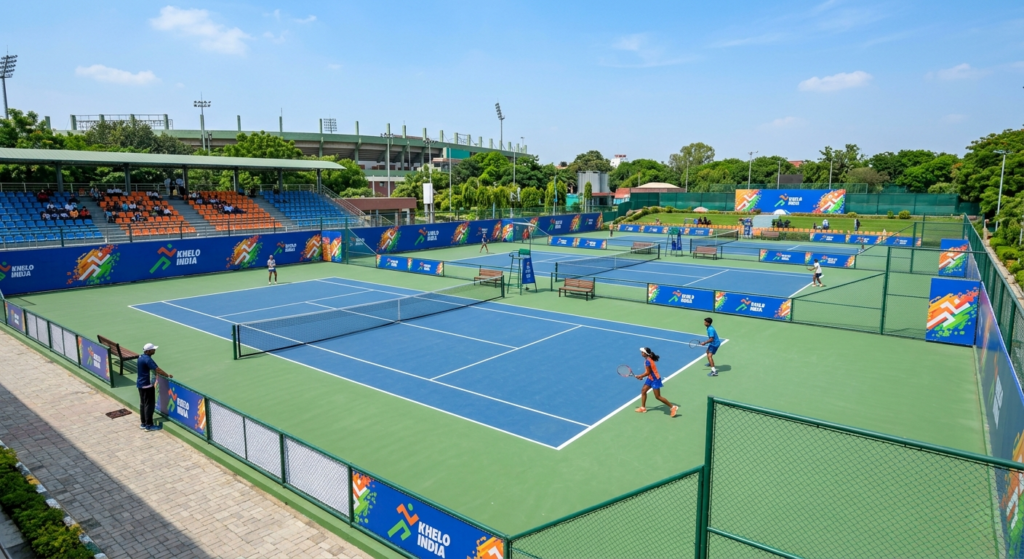
Khelo India Tennis Court Grant Scheme (2026)
Under the 2026 Khelo India scheme, state governments can apply for central grants to build or upgrade tennis courts at government schools, sports hostels, and district sports complexes. The grant covers up to 60% of construction cost, with a cap of ₹15 lakh per court. The scheme requires courts to meet full ITF dimension standards, use certified contractors from AITA’s approved vendor list, and include flood-lighting at minimum 400 lux.
AITA Court Certification Process (2026 Update)
AITA introduced a three-tier certification system for tennis courts in 2026. Tier 1 certifies courts for national and Davis Cup-level play. 2 Tier certifies courts for state championships and ranking tournaments. 3rd Tier certifies courts for district competitions and school sports. The certification involves a laser-measurement audit, surface friction test, net tension check, and drainage inspection. Courts must renew certification every three years.
Green Court Initiative – India 2026
India launched the Green Court Initiative in early 2026 under SAI’s sustainable sports infrastructure programme. This programme encourages the use of recycled rubber base layers beneath acrylic courts, solar-powered floodlighting, and rainwater harvesting systems integrated into court drainage. Courts built under this initiative receive an additional 10% grant top-up from the Ministry of Environment’s Sports-Green Fund.
Case Study – Jaipur District Tennis Complex, Rajasthan
Background: The Rajasthan State Sports Council commissioned a new tennis complex in Jaipur in mid-2025. The project aimed to create a tournament-grade facility under the Khelo India scheme, capable of hosting state-level championships and serving as a training centre for junior players.
Project Scope: The Jaipur District Tennis Complex was developed on a 1.2-acre site in the Mansarovar Sports Zone. The project included six standard hard courts (ITF dimensions: 23.77 m × 10.97 m), one centre court with covered seating for 300 spectators, LED floodlighting at 500 lux, a AITA Tier 2 certified surface, and a coaching facility with video analysis rooms.
Dimension Challenges: The original site plan allocated insufficient run-off zone behind the western baseline courts due to a boundary wall. The project team consulted AITA’s 2026 guidelines and redesigned the court layout, rotating the court cluster by 12 degrees to achieve the mandatory 6.40-metre clearance. This required removal of a storage structure and reallocation of 180 square metres.
Investment: Total project cost: ₹2.8 Crore. Khelo India central grant: ₹72 lakh (covering six courts at ₹12 lakh each). State government contribution: ₹1.2 Crore. Private CSR funding from a Jaipur-based cement manufacturer: ₹88 lakh.
Outcome: The complex received AITA Tier 2 certification in January 2026 and hosted the Rajasthan State Junior Tennis Championship in February 2026. Enrolment in the junior training programme crossed 200 players within two months of opening. The facility is now a model project under the Khelo India showcase programme, with AITA recommending it as a blueprint for Tier-2 city tennis complexes across India.
Key Lesson: Accurate dimension planning – especially run-off zone compliance – must happen at the land assessment stage, not after construction begins. The Jaipur project’s mid-construction correction cost an additional ₹14 lakh and delayed opening by six weeks.
Transform Your Sports Facility Today!
Contact us for high-quality synthetic sports flooring material and elevate your space!
Common Mistakes in Tennis Ground Construction
Ignoring Run-Off Zone Requirements
Many smaller clubs and school authorities in India build courts that meet the 23.77 × 10.97 metre playing area but neglect the mandatory run-off zones. This results in player safety hazards and disqualifies the venue from AITA-certified tournament hosting. Always calculate total land requirement including clearance zones before finalising site selection.
Incorrect Line Marking Dimensions
Line markings carry strict width specifications. The ITF mandates that all lines except the baseline must be 2.5–5 centimetres (1–2 inches) wide. The baseline may be up to 10 centimetres (4 inches) wide. Incorrect line widths cause confusion during play and fail certification audits. India’s 2026 AITA audit data shows that 23% of inspected courts had line marking errors.
Net Post Placement Errors
Net posts must stand 0.914 metres outside the doubles sideline on each side, making the total post-to-post distance 12.80 metres. Misplacing net posts is one of the most common construction errors in India. It affects net tension, sag, and play fairness.
Surface Level and Drainage
Courts must maintain a maximum slope of 1% (1 centimetre per metre) for water drainage. Flat courts with no drainage crown cause water pooling, surface damage, and player injury risk. In India’s monsoon-affected regions (Kerala, Assam, West Bengal), proper drainage design is critical to court longevity.
Conclusion
Tennis ground measurements is the foundation upon which every aspect of the game is built. The ITF’s precisely defined dimensions 23.77 metres in length, 8.23 metres for singles, 10.97 metres for doubles have stood the test of time and continue to define the sport at every level, from a school court in Varanasi to the Centre Court at Wimbledon.
In India’s rapidly evolving sports infrastructure landscape of 2026, understanding these dimensions goes beyond measurement. It means navigating AITA certification tiers, leveraging Khelo India construction grants, adopting green court practices, and planning complete complexes that serve communities for decades. Whether you are building one court or twelve, the dimensions are the same but the planning, investment, and impact can transform the next generation of Indian tennis. Get the measurements right from day one, follow AITA’s 2026 updated guidelines, and build courts that last, perform, and inspire.
Frequently Asked Questions (FAQs)
A standard tennis court measures 23.77 metres in length and 10.97 metres in width for doubles play.
A singles court is 8.23 metres wide, while a doubles court is 10.97 metres wide – a difference of 2.74 metres on each side.
Including run-off zones, a single tennis court requires approximately 595–1,000 square metres of total land depending on amenities.
The net stands at 0.914 metres (3 feet) at the centre and 1.07 metres (3.5 feet) at the net posts.
Yes, AITA fully adopts ITF standard dimensions for all certified courts and tournaments across India in 2026.
The Khelo India 2026 scheme provides up to 60% of construction cost as a central grant, capped at ₹15 lakh per standard tennis court.